Invasive Species Management
and Impacts
Invasions should only be suppressed if they have negative ecological or economic impacts and if suppression is expected to mitigate those impacts. Understanding the impacts of both invasions and our efforts to control them is therefore critical for informing effective management. However, despite important progress towards understanding these impacts, we still often lack the site-specific understanding (i.e. quantitative evidence on the relative cost vs. benefit of different management actions) needed to inform local management decisions. To this end, I am developing a conceptual framework that outlines the responsibilities that scientists, managers, and funders can adopt to overcome traditional challenges and hold each other accountable to an evidence-based framework on invasive species management. I designed this framework to recognize that, moving forward, we need to better support managers—who have limited time and resources—to collect evidence of the impacts of invasions and their management.
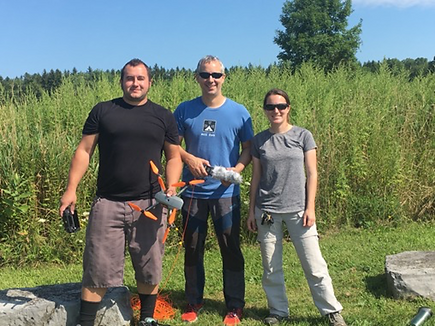
In addition to a conceptual framework, I am also passionate about developing more accurate, efficient, and cost-effective tools to assess these impacts. For example, I am collaborating with Holger Klinck and his team at the Cornell Lab of Ornithology to use stationary recorders to monitor how bird, frog, and toad calls change in response to invasions. As part of this project, we are working with the Chemnitz University of Technology to adapt BirdNET (a machine learning algorithm) to efficiently and effectively automate wetland bird, frog, and toad species identification. We are also experimenting with using microphones tethered to drones to be able fly over wetlands, and spatially pinpoint exactly where individuals are calling. Moving forward, we hope to overlay the spatial map of calls with aerial photography, which will allow us to disentangle exactly which species use which types of vegetation within these wetland habitats.